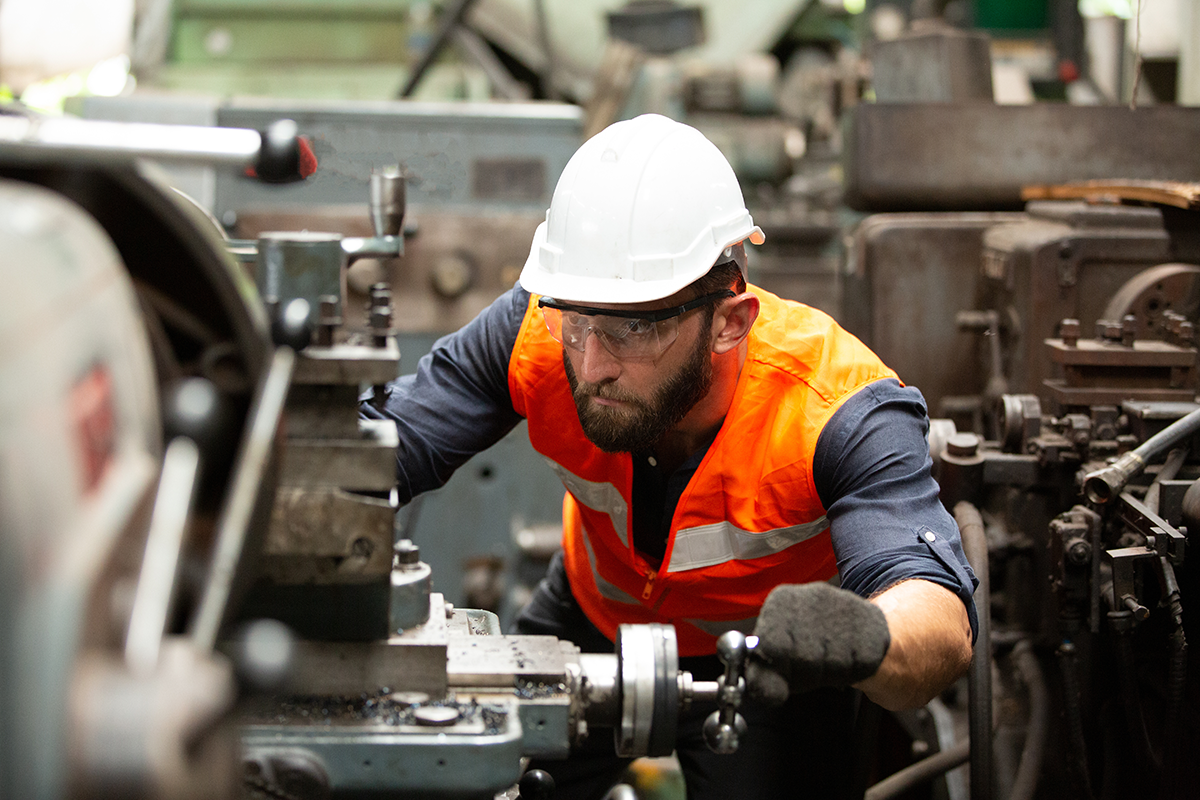
Artificial intelligence is becoming increasingly important in metal manufacturing. From automated quality control to tool wear monitoring and intelligent production planning, new opportunities are emerging to make manufacturing processes more efficient. But how far has the industry actually come? Which applications are already practical, and where does the greatest potential lie?
AI in the Metal Industry: From Pilot Projects to Industrial Practice
The metal manufacturing industry faces the challenge of balancing high-quality standards, cost-effective manufacturing processes, and reliable order fulfillment. At the same time, there is growing interest in technologies that help companies better monitor and optimize complex processes. Artificial intelligence is playing an increasingly important role in this regard.
A VDMA survey conducted in the spring of 2026 shows that over 80 percent of the mechanical engineering companies surveyed believe AI technologies are becoming increasingly important. About one-third are already using AI solutions in production. However, current use is heavily concentrated in software development, design, and business management. There remains potential for application in actual manufacturing. The figures refer to the mechanical engineering sector and not exclusively to metalworking companies.
According to the Deloitte study “AI in Manufacturing 2026,” 84 percent of the manufacturing companies surveyed report measurable added value from AI. At the same time, only about 20 percent of the use cases examined have been fully scaled. There therefore remains a gap between successful individual projects and broad industrial adoption.
For metalworking companies, this leads to an important insight: AI is already technologically viable in many areas. It is becoming increasingly crucial to identify suitable use cases and integrate the technology effectively into existing manufacturing processes.
What AI applications are used in metal fabrication?
Possible applications range from monitoring individual processing steps to optimizing overarching production processes. Of particular interest are applications in which machine and process data are used to detect deviations early on or to improve decision-making.
1. Automatically detect tool wear during milling
The condition of cutting tools has a direct impact on the quality and cost-effectiveness of manufacturing. If tools are replaced too late, quality deviations can occur. Replacing them too early, on the other hand, prevents them from reaching their full service life. The Fraunhofer IPT, in collaboration with research partners, has developed a method that uses camera technology and AI to monitor tool wear during milling in near real time. The captured images are automatically analyzed, allowing the tool’s condition to be assessed directly in the manufacturing environment. The wbk Institute for Production Engineering at KIT is also working on this application. There, a smart camera was integrated into a milling machine to detect and classify areas of wear using deep learning. The researchers report a detection accuracy of over 90 percent. Furthermore, the remaining tool life can be predicted based on the process parameters. These approaches demonstrate how AI can support condition-based maintenance and enable a more needs-based use of tools.
2. Detecting Quality Deviations During Machining
Not all quality issues can be immediately detected on the finished workpiece without conducting additional inspections. Quality control is therefore particularly labor-intensive in the case of demanding machining processes. In the “FL.IN.NRW” research project, the Fraunhofer IPT is collaborating with industry partners to investigate how AI models can detect quality deviations based on machine and process data. To this end, changes in spindle load and cutting pressure, among other factors, are being analyzed. These signals are used to draw conclusions about dimensional deviations resulting from tool wear. A distinctive feature of the project is the use of federated learning, which allows AI models to be trained decentrally without the need to consolidate all production data centrally. This opens up opportunities for cross-organizational further development of AI models without having to fully exchange sensitive manufacturing data. The project illustrates how, in the future, quality inspection can be shifted more toward the ongoing machining process rather than relying exclusively on downstream checks.
3. Reduce scrap in sheet metal fabrication
New opportunities are also emerging in sheet metal processing to detect quality deviations immediately during production. With “Inform-QC,” the Fraunhofer IGD has introduced a camera-based system for inline quality control of stamping and forming processes. It captures the surfaces of components and compares their topography with a reference state. This allows for the detection of changes that may indicate, for example, tool wear. The analysis can be performed at production speeds of up to 400 strokes per minute without slowing down the production cycle. If deviations are detected early, companies can react more quickly and limit the production of additional defective components. The approach is being further developed for lubricated metal surfaces, among other applications.
4. Optimize material usage and sheet metal cutting
In addition to quality control, AI-powered image processing also offers potential in the area of material utilization. In laser cutting, for example, intelligent camera systems can detect the position of previously processed or bent sheet metal and assist with its alignment. Furthermore, existing scrap sheets can be identified so they can be reused for additional cuts. This reduces the need for manual alignment steps and allows for better utilization of existing material resources. This is a particularly interesting approach—especially for material-intensive manufacturing processes—to combine cost-effective and resource-efficient production processes.
What determines the success of AI implementation?
The examples show that AI can already perform a variety of tasks in metal manufacturing. However, the technical feasibility of a use case does not automatically mean that it is also economically viable. According to Deloitte, high implementation costs (43 percent), a lack of technical expertise (35 percent), and resistance to change (35 percent) are among the most frequently cited challenges in AI adoption. Data availability and data quality also play an important role.
Before implementing a system, companies should answer three questions:
Problem:
Where are avoidable costs or delays occurring today—for example, due to scrap, downtime, or time-consuming rescheduling?
Data source:
What data does the application need, what data is already available, and how reliable is it?
Success criterion:
Which metric should be used to demonstrate the benefit, and what baseline value serves as a point of comparison?
A good place to start is a clearly defined problem with a robust data foundation and a verifiable goal. This makes it possible to assess whether the application will deliver the expected benefits within your own organization.
AI-Based Production Planning: Taking Dependencies Beyond Individual Machines into Account
Tool monitoring and quality control are carried out during individual machining processes. Production planning links these processes: It must coordinate orders, machines, materials, and personnel in such a way that promised delivery dates can be met.
For example, a component undergoes turning, milling, and a subsequent surface treatment. Available capacity on the lathe alone is not sufficient to guarantee a reliable delivery date. The subsequent processing steps, setup times, and required staff must also be available. If one step is delayed, other orders may be affected. A robust production planning system ( detailed scheduling ) must take precisely these dependencies into account. At its core, the question is: How can orders, resources, and production steps be coordinated so that the entire production process runs economically and reliably?
In metal fabrication in particular, it is often necessary to coordinate several consecutive production steps. For example, a component is first turned, then milled, drilled, and, if necessary, surface-treated before it proceeds to assembly or shipping. Each step requires specific machines, capacity, materials, and qualified personnel. Added to this are varying processing times, setup procedures, machine utilization, and delivery dates. If one step is delayed, it may affect subsequent processes and other orders. AI-based detailed scheduling can account for such dependencies throughout the entire manufacturing process.
Economic developments also place greater demands on planning: When raw material prices are high or fluctuate widely, large inventories can incur significant costs and tie up capital. A more demand-driven approach to procurement and manufacturing may therefore be advisable. To ensure that materials are available when they are actually needed, up-to-date and reliable production plans are crucial.
Added to this is the high proportion of high-mix production in many European metalworking companies. Under the “high mix, low volume” (HMLV) principle, numerous different—and often complex—components are produced in small quantities. Frequent changes in orders, customized work sequences, and flexible, partially automated production cells make dynamic detailed scheduling particularly challenging. The more flexible the production, the more important it becomes to coordinate all available resources.
Planning is particularly challenging in metalworking shops with many variants and small batch sizes—often referred to as “high-mix, low-volume” (HMLV). Different work sequences, frequent setup changes, and shared machinery and personnel resources create numerous dependencies. Frequent order changes, customized work sequences, and flexible, partially automated production cells make dynamic detailed scheduling particularly challenging. The more flexible the production, the more important it becomes to coordinate all available resources.
Deloitte reports an average improvement potential of 21 percent for lead time per unit in both discrete and process manufacturing. This figure from the study refers to AI applications in general and does not constitute a specific performance guarantee for production planning software.
How PAILOT Supports Production Planning in Metal Fabrication
One concrete approach to this comprehensive optimization is PAILOT, an AI-based detailed planning software. It not only schedules production orders for individual machines or manufacturing areas but also takes into account dependencies throughout the entire production process. This makes it clear to planning managers how a decision will affect subsequent operations and delivery dates.

Optimized setup procedures:
Forlathes and milling machines, jobs with similar setup requirements can be scheduled in an appropriate sequence. This helps reduce unnecessary tool and machine changeovers.
Bottleneck Optimization:
PAILOTtakes available machine capacity into account and helps identify bottlenecks early on. Production orders can thus be coordinated so that critical resources are used as efficiently as possible.
Optimization of optional manufacturing steps:
Notevery order has to go through the same production steps. For example, surface treatment may be required only for certain components. The " detailed scheduling " can account for such optional steps and capacity dependencies.
Optimized Staffing and Multi-Machine Operation:
In addition to machine capacities, PAILOT also takes into account employee availability and qualifications. This is particularly relevant when multiple machines are being operated: If one person is responsible for several machines, their scheduling and the available personnel resources must be planned together.
Improved predictability in material procurement:
Byscheduling production orders proactively, it becomes clear when materials are actually needed. This can help ensure that procurement is better aligned with demand.
Improved on-time delivery:
By consideringmachine capacity, material availability, and work sequences together, it is possible to create more realistic production schedules. In the event of last-minute changes, the impact on other orders can be taken into account.
The advantages described are potential optimization effects, not performance metrics that have been empirically verified here. A key advantage is cross-departmental planning. In practice, different planning managers often optimize their own production areas without being able to see the full impact on subsequent processes. In other companies, production planning ( detailed scheduling ) focuses on known bottleneck machines, while other resources are only roughly scheduled. PAILOT, on the other hand, can view machines, operations, and their interdependencies as a whole. These interrelationships become transparent and traceable for planning managers.
Planning becomes particularly complex when employees operate multiple machines or when certain qualifications are in short supply. This is where PAILOT’s strength lies: in the joint optimization of both machines and employees. The APS (Advanced Planning and Scheduling) system helps evaluate different planning alternatives and coordinate resources. The final planning decision remains with the human planner.
Conclusion: AI doesn't start with the technology
Artificial intelligence has long been more than just a topic for the future in metal manufacturing. Research projects and industrial applications demonstrate how tool conditions can be monitored automatically, quality deviations detected early on, and manufacturing processes optimized based on data. At the same time, recent industry studies show that many companies still face the challenge of permanently integrating successful individual applications into their processes.
Therefore, the key is not to introduce as many AI applications as possible as quickly as possible. Rather, companies should start where specific challenges exist and where measurable benefits can be achieved. Whether in quality assurance, tool monitoring, or production planning, AI can help metalworking companies make better use of their existing resources and make their manufacturing processes more cost-effective.
The starting point should not be the technology, but rather the problem that needs to be solved.