Full order books are generally good news. For electronics manufacturers, however, they can quickly become a planning challenge: Different assemblies compete for the same machines, materials are not available when planned, and qualified personnel are in short supply. At the same time, delivery deadlines must be met and available resources used as efficiently as possible.
In this complex interplay, bottlenecks in electronics manufacturing can disrupt the entire production flow. Even if most of the production process has spare capacity, a single overloaded resource can cause orders to be delayed, lead times to increase, and downstream processes to be unable to operate as planned.
A particular challenge: Bottlenecks are generally static. Depending on the order mix, material availability, setup time, or machine utilization, a different resource may become a bottleneck today than it will tomorrow. But where do bottlenecks arise in electronics manufacturing, what are their consequences, and how can they be identified early on through proactive production planning?
What does a bottleneck in electronics manufacturing mean?
A bottleneck occurs when the required capacity of a resource exceeds its available capacity. The machine, piece of equipment, or personnel in question cannot handle the workload within the required time.
Here's a simple example: If the scheduled orders require 50 production hours on an SMT line within a week, but only 40 hours are available, there is a 10-hour capacity shortfall. The SMT line becomes the bottleneck.
There are essentially two types:
Structural bottlenecks are a persistent problem. The available capacity of a resource is often insufficient to meet production demand.
Temporary or dynamic bottlenecks, on the other hand, arise from the current production situation. For example, if several urgent orders are assigned to the same machine at the same time, that machine can become a bottleneck in the short term—even though its capacity is normally sufficient.
Especially in electronics manufacturing—with its wide variety of product variants, varying lot sizes, and changing production orders—such bottlenecks can shift repeatedly. For production planning, it is therefore not enough to simply keep an eye on known bottleneck machines. It is crucial to recognize when and where new bottlenecks arise due to the current order and capacity situation.
Where do bottlenecks occur in electronics manufacturing?
Bottlenecks can occur at virtually any stage of the production process. Often, they are actually caused by the interplay of several factors.
Machinery and Equipment
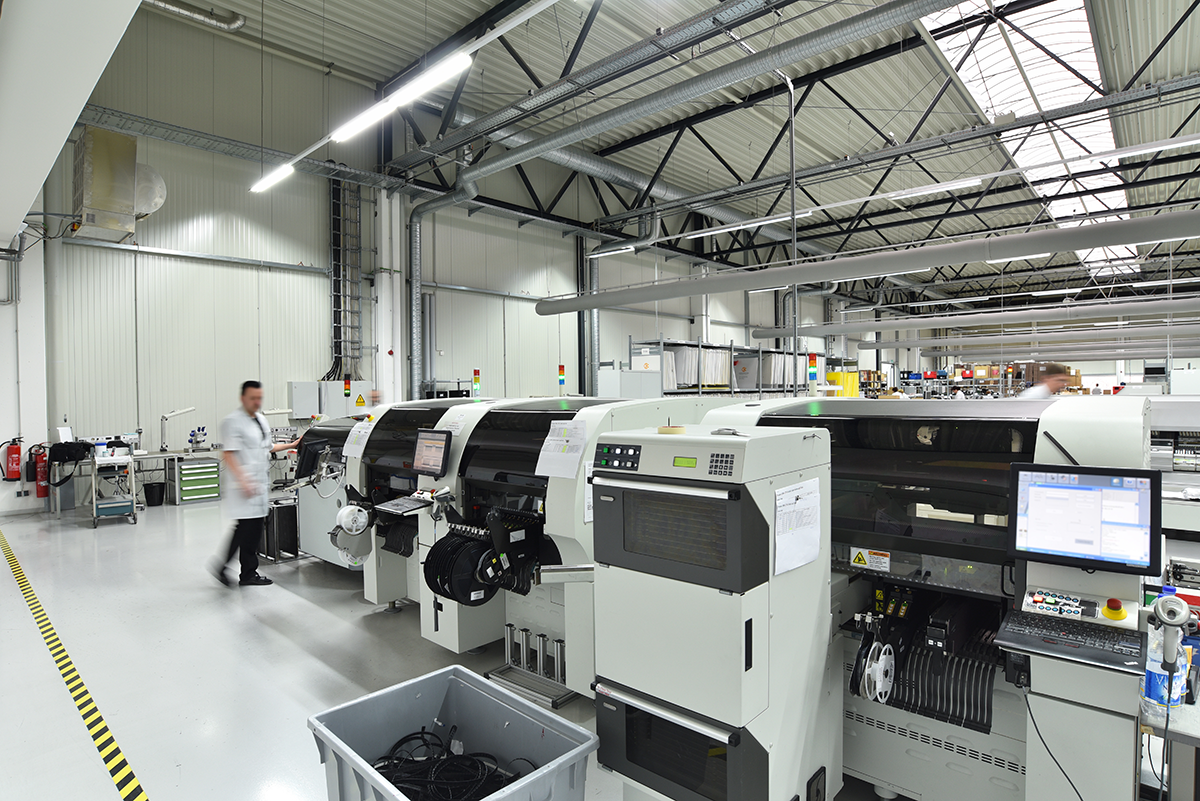
Machinery and production equipment are among the most obvious bottleneck resources. In electronics manufacturing, for example, an SMT line or individual stations—such as an automatic placement machine, a selective soldering system, or other specialized equipment—can become bottlenecks.
This does not necessarily mean that there is an inherent shortage of machine capacity. If multiple orders require the same machine within the same time frame, or if a subassembly can only be manufactured on a specific machine due to technical requirements, this can lead to short-term overloads. Unplanned machine downtime also reduces available capacity.
Setup Times and Production Sequence
Setup times play a particularly important role in high-mix/low-volume manufacturing. For example, frequent product changes require feeders, components, programs, or stencils to be swapped out and made available. In capacity planning, setup times are usually already included in the booking time. However, with frequent product changes, they consume a significant portion of available capacity and can exacerbate existing bottlenecks. This makes the order in which jobs are processed all the more important: An appropriate sequence reduces unnecessary setup operations and makes better use of available production time.
Staff and Qualifications
Manual and semi-automated processes can also cause bottlenecks. This applies, for example, to manual assembly, installation, rework, or quality inspections. The key factor here is not just the number of available employees. If specific qualifications are required for a particular work step, the availability of personnel can also become a bottleneck. Vacation, illness, or changes in shift schedules can further reduce available capacity.
Material Availability
An available machine is of little use if the necessary materials are missing. Especially with extensive bills of materials, even a single missing component can prevent a production order from starting as planned. Material shortages also frequently affect further production planning: If an order is delayed due to a missing component, it may later compete with other orders for the same machine capacity. As a result, a material shortage can also lead to a capacity shortage.
Inspection, Testing, and Equipment
AOI, ICT, functional tests, and manual quality inspections can also slow down the production flow. If assemblies are manufactured faster than they can be inspected, bottlenecks occur and work in progress (WIP) increases. The same applies to shared equipment such as stencils, test adapters, or product-specific fixtures. Even if machines and personnel are available, the order still cannot be processed if the necessary equipment is missing.
Production Planning Itself
Not every bottleneck is caused by an actual lack of capacity. Poor production planning can also create or exacerbate bottlenecks. If multiple orders are scheduled for the same resource at the same time, or if setup times, material availability, qualifications, and process dependencies are not adequately taken into account, peak workloads can occur. At the same time, capacity may remain unused elsewhere.
For realistic production planning, therefore, it is necessary to take into account not only individual resources but also their dependencies and constraints throughout the entire production process.
What are the consequences of bottlenecks for production?
A bottleneck rarely remains an isolated problem. If a production step cannot be carried out as planned, its effects can ripple through the entire production process. Orders pile up before a bottleneck resource. Work in progress increases, while lead times lengthen. Downstream workstations, on the other hand, may be waiting for assemblies and unable to fully utilize their available capacity. If a bottleneck is not identified until production is already underway, a quick response is required: orders are rescheduled, priorities are adjusted, alternative machines are sought, or additional shifts are considered. This increases the planning effort and can have further repercussions on orders that have already been scheduled.
A single bottleneck can thus trigger a chain reaction:
Bottleneck → Backlog → Longer lead time → Rescheduling → Rising costs → Delivery dates at risk
If lost time cannot be made up, the internal capacity problem ultimately becomes a problem for the customer: on-time delivery rates decline. At the same time, overtime, extra shifts, express deliveries, or external manufacturing capacity can result in additional costs.
How can bottlenecks be identified and avoided early on?
Not every bottleneck can be prevented. Machines can break down, materials can arrive late, and last-minute orders can shift priorities. Therefore, the key is not so much to completely eliminate every bottleneck as it is to identify it as early as possible.
The basis for this is realistic capacity planning. Instead of considering only theoretical machine hours, the actual usable capacity must be taken into account. Shift schedules, setup times, maintenance, staffing, and other constraints reduce the time that is actually available for production orders. This capacity is then compared with the specific demand of the planned orders. This allows future capacity peaks to be identified before they impact production.
At the same time, planning must not view machines in isolation. An order can only be realistically scheduled if materials, personnel, resources, and upstream and downstream processes are also available at the required time. The production sequence also plays an important role. A well-chosen sequence can, for example, reduce setup time and make better use of available capacity. However, different objectives must be balanced against one another: An optimal setup sequence is of little help if it jeopardizes an important delivery date. And finally, production planning must remain dynamic. If material availability, order volume, or machine capacity changes, the impact of these changes on the overall production plan must be assessed.
The sooner a potential bottleneck becomes apparent, the greater the room for maneuver: orders can be reprioritized, alternative resources can be utilized, sequences can be changed, or additional capacity can be specifically scheduled.
Identify Bottlenecks Early with PAILOT
The more complex electronics manufacturing becomes, the harder it is to keep track of all orders, capacities, and restrictions at the same time. This is exactly where intelligent production planning with PAILOT comes in.
PAILOT helps electronics manufacturers realistically map existing capacities, identify potential bottlenecks early on, and plan production orders while taking relevant constraints into account. Upcoming production orders are compared against available capacities. If it becomes apparent that a resource will be utilized beyond its capacity within a specific time period, this conflict can be addressed as early as the production planning stage.
At the same time, various dependencies within the manufacturing process are taken into account. Rather than simply scheduling orders into available time slots, factors such as available resources, delivery dates, material availability, and production-related constraints can be incorporated into the optimization of the production plan. If the initial situation changes—for example, due to an urgent order, delayed materials, or an unavailable resource—planning can be adjusted based on the new conditions. This approach considers not only the orders directly affected but also the ripple effects on other orders. The goal here is not to eliminate bottlenecks from production entirely. The key is to identify bottlenecks before they become acute problems—and to plan around them as effectively as possible using available capacity.
Managing Bottlenecks Rather Than Just Reacting to Them
Bottlenecks are a reality, especially in the diverse and dynamic world of electronics manufacturing. They become particularly problematic when they only become apparent after the production flow has already been disrupted. Proactive production planning therefore provides transparency regarding where future capacity conflicts will arise and which orders will be affected. This allows sufficient time to explore alternatives and deploy available resources more effectively. The key advantage, then, is not in preventing every bottleneck—but in knowing sooner where the next one will occur.