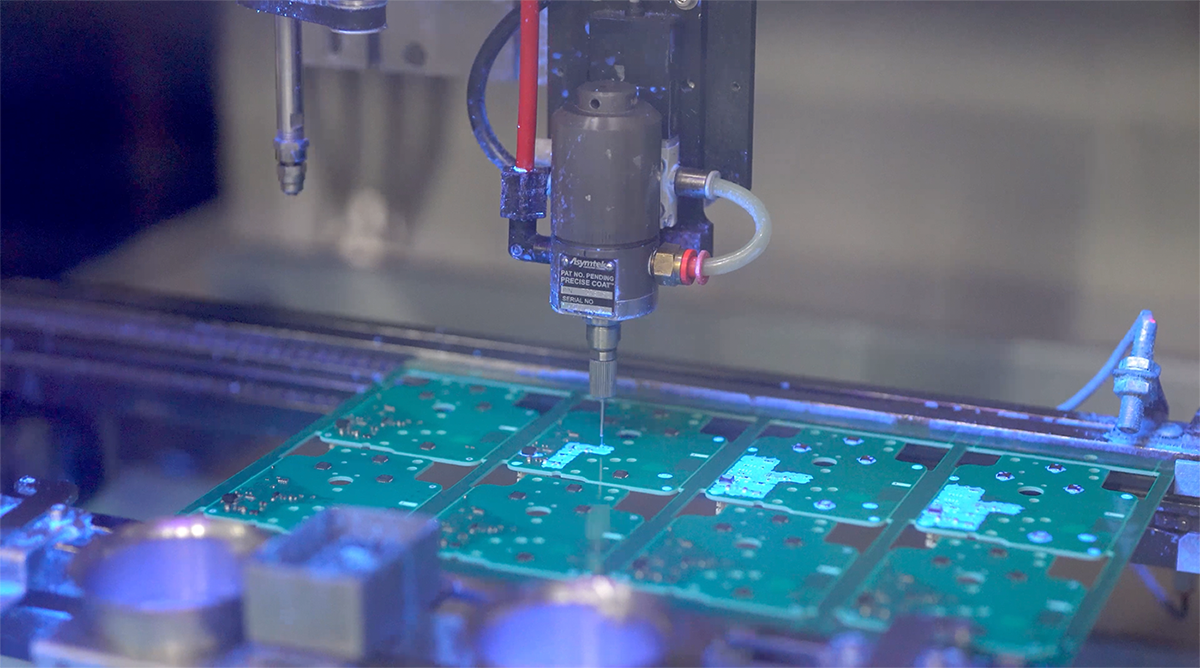
Artificial intelligence is no longer a topic for the future in electronics manufacturing. At the same time, the industry is still relatively in the early stages of its development: While some companies are already using specific AI applications, others are just beginning to explore where AI can create meaningful added value in their manufacturing processes.
From our perspective, now is an interesting time for this discussion. At PAILOT, we deal daily with two topics that intersect: the specific requirements of electronics manufacturing and the use of AI in industrial processes. That’s why we want to take a look at the current state of affairs: How far has AI actually come in electronics manufacturing? What applications are already available? What prerequisites are needed? And how can companies figure out where it makes sense for them to get started?
Electronics manufacturing is a particularly interesting field for AI
Electronics manufacturers face challenges that cannot simply be summarized under the general term “increasing production complexity.” Electronic assemblies are becoming smaller and more complex, while at the same time there are high demands for quality and process reliability.
Messe Stuttgart cites miniaturization, increasing complexity, a shortage of skilled workers, and the need for more resilient production structures, among other factors, as key challenges in electronics manufacturing. As a result, researchers and industry are focusing intensively on automation, digitalization, and AI-based processes. (Messe Stuttgart/EFX) Added to this are the unique characteristics of the manufacturing process itself: SMT lines, varying setup conditions, testing and inspection processes, and a wide variety of different assemblies generate numerous data points and potential areas for optimization. It is precisely this combination that makes it interesting for AI: there are complex processes, recurring decisions, and large volumes of production data—and thus numerous potential use cases.
So the question is not so much whether AI can become relevant to electronics manufacturing. What’s more interesting is where the industry actually stands today.
Where does AI stand in electronics manufacturing today?
A study by SmartRep and Xplain Data provides insight into companies in the DACH region. About 35 percent of the companies surveyed are already using AI or analytics in production or as part of pilot projects. At the same time, more than 70 percent plan to invest in AI and digitalization over the next one to two years. (SmartRep/Xplain Data)
A look at German industry as a whole also reveals a clear trend. In the Bitkom 2025 study, 82 percent of the industrial companies surveyed say that AI will be crucial to the competitiveness of German industry in the future. At the same time, only 24 percent report that they are already successfully harnessing the potential of AI for their own companies. (Bitkom, Industry 4.0, 2025) It is precisely this gap that is interesting: The potential of AI has long been recognized—yet its practical implementation is still far from a given in many places.
For electronics manufacturers who have had little or no experience with AI so far, this is an important insight: The market hasn’t left them behind yet. But the phase in which companies define their areas of application, gain experience, and implement concrete applications has already begun. It’s therefore not a matter of implementing “anything with AI” as quickly as possible. A much more important question is: Where can AI solve a specific problem in our own manufacturing operations?
What are other electronics manufacturers already doing with AI?
AI is already being used for specific tasks in electronics manufacturing today. This is particularly evident in three areas:
Quality Control:
One well-established application is automated optical inspection (AOI). For example, Fraunhofer IPA, OPTIMUM Data Management Solutions, and other providers have developed machine-learning methods that can distinguish actual defects from so-called pseudo-defects when inspecting assembled printed circuit boards. This helps reduce the effort required for manual follow-up inspections. (Fraunhofer IPA)
Error and Root Cause Analysis:
AI can also help not only to detect defects but also to understand how they arise. To this end, Fraunhofer IZM is investigating the joint analysis of data from solder paste inspection (SPI) and automated optical inspection (AOI). The goal is to identify correlations between process steps and defects that occur later on. (Fraunhofer IZM)
Process Optimization:
Data-driven systems are also used during ongoing SMT production. ASMPT, for example, describes solutions that consolidate data from printing, placement, and inspection processes. Based on this data, process parameters can be adjusted, recurring problems identified, or opportunities for optimization within an SMT line recognized. (ASMPT)
The examples show that AI is already being used in practice in electronics manufacturing—though not as a universal solution, but rather to address specific challenges within the manufacturing process.
What does it take to get started with AI in electronics manufacturing?
Anyone looking to use AI in electronics manufacturing doesn't need a comprehensive AI strategy or a fully developed data infrastructure right away. The key first step is to identify a specific use case and assess the necessary prerequisites.
Data plays an important role in this context. More than 80 percent of the companies surveyed by SmartRep and Xplain Data already collect quality, inspection, and machine data. At the same time, only 14 percent rate their own data quality as high. (SmartRep/Xplain Data) However, this does not mean that companies must first clean up all their data before they can start using AI. Which data is needed and what quality it must have depends on the specific use case.
At the same time, the Bitkom figures show that the challenge lies not solely in the data set. 42 percent of the industrial companies surveyed state that they lack the expertise to integrate AI into their processes. 50 percent are taking a wait-and-see approach to AI implementation, waiting to see what experiences other companies have. (Bitkom, Industry 4.0, 2025) This makes it clear: For many companies, the question is no longer whether AI is relevant in principle, but rather how to successfully make the transition from potential to concrete application.
To get started, here are three questions to help you out:
1. What problem do we want to solve?
For example, where do high manual effort, quality issues, inefficient processes, or complex decisions arise?
2. What are the requirements for this use case?
What machine, quality, order, or process data is needed? Is this data available and usable enough? And where specifically does data quality need to be improved?
3. What measurable benefits do we expect?
Success should not be measured by whether AI is used, but rather by factors such as fewer defects, reduced time spent, or improved on-time delivery.
So the starting point shouldn't be the question, "Where can we use AI?" but rather, "What problem do we want to solve—and what do we need to do that?"
Production planning is one such use case
Depending on the situation, the answer to this question can vary greatly. One possible use case is production planning—an area we focus on extensively at PAILOT.
Challenging optimization problems arise here, particularly in electronics manufacturing: Orders must be allocated to available resources, setup processes must be taken into account, material availability must be checked, and delivery deadlines must be met. If one condition changes, it can affect numerous other orders. The fact that AI is becoming increasingly relevant in this area is also demonstrated by the latest Bitkom study for 2026: 40 percent of the industrial companies surveyed are already using AI for intelligent control and planning, and another 38 percent plan to do so. (Bitkom, Industry 4.0, 2026)
An APS (Advanced Planning and Scheduling) system can help planners take such dependencies into account simultaneously and optimize production schedules. For us, this is a good example of how AI should be used in an industrial setting: not because a company wants to “use AI,” but because a specific, complex problem needs to be solved more effectively. We therefore employ intelligent optimization methods in areas where operational production decisions are made on a daily basis. People remain an integral part of the planning process. The technology helps them take into account a large number of constraints and possible planning scenarios.
Production planning is therefore one possible use case for AI in electronics manufacturing—alongside quality inspection, process analysis, and other areas of application.
AI doesn't start with the technology
AI already offers concrete opportunities for electronics manufacturing—and development is continuing to gain momentum. The key is not to implement as many AI applications as possible or to follow every new trend. Based on our experience with AI and electronics manufacturing, a different approach is more promising: First comes the problem, then the technology.
Whether it’s quality control, process optimization, or production planning: Companies should start where there is a concrete need for improvement today and then assess how AI can help address it. Those who take this approach don’t have to wait for the perfect time to implement AI. They can start where it will generate the greatest value for their own manufacturing operations.
Sources:
ASMPT (n.d.): WORKS Optimization – Intelligent Process Optimization Along the Entire SMT Line.
https://smt.asmpt.com/de/produkte/software-solutions/works/works-optimization/
Bitkom e. V. (2025): Industry 4.0. Bitkom Study 2025. Berlin: Bitkom e. V. DOI: 10.64022/2025-industrie-4-0.
https://www.bitkom.org/sites/main/files/2025-09/bitkom-studienbericht-industrie40.pdf
Bitkom e. V. (2026): Industry 4.0: How Digital Is Germany’s Industry? Berlin: Bitkom e. V., April 14, 2026. DOI: 10.64022/2026-industrie-4.0.
https://www.bitkom.org/Bitkom/Publikationen/Industrie-40-Wie-digital-ist-Deutschlands-Industrie
Fraunhofer Institute for Manufacturing Engineering and Automation IPA (n.d.): Automated Optical Inspection (AOI) with Machine Learning. Fraunhofer IPA, Stuttgart.
https://www.ipa.fraunhofer.de/de/referenzprojekte/AOI.html
Landesmesse Stuttgart GmbH & Co. KG (n.d.): In the Spotlight: Future Trends in Electronics Manufacturing. EFX – Expo for Electronics Manufacturing.
https://www.messe-stuttgart.de/efx/en/fair/future-trends/
Shousha, K.; Arnhold, K.; Roth, L. (2026): SMD Placement with AI: Optimized SPI/AOI Workflows for Higher Manufacturing Quality. RealIZM, Fraunhofer Institute for Reliability and Microintegration IZM, March 19, 2026.
https://blog.izm.fraunhofer.de/de/smd-inspektion-mit-ki/
Xplain Data GmbH & SmartRep GmbH (2026): Results: Survey on AI & Digitalization in Electronics Manufacturing.Analysis report on a survey of employees at various electronics manufacturing companies, conducted in December 2025. Xplain Data GmbH & SmartRep GmbH.
https://xplain-data.de/wp-content/uploads/2026/01/AUSWERTUNGSBERICHT-Umfrage-KI-in-der-Elektronikproduktion-2.pdf