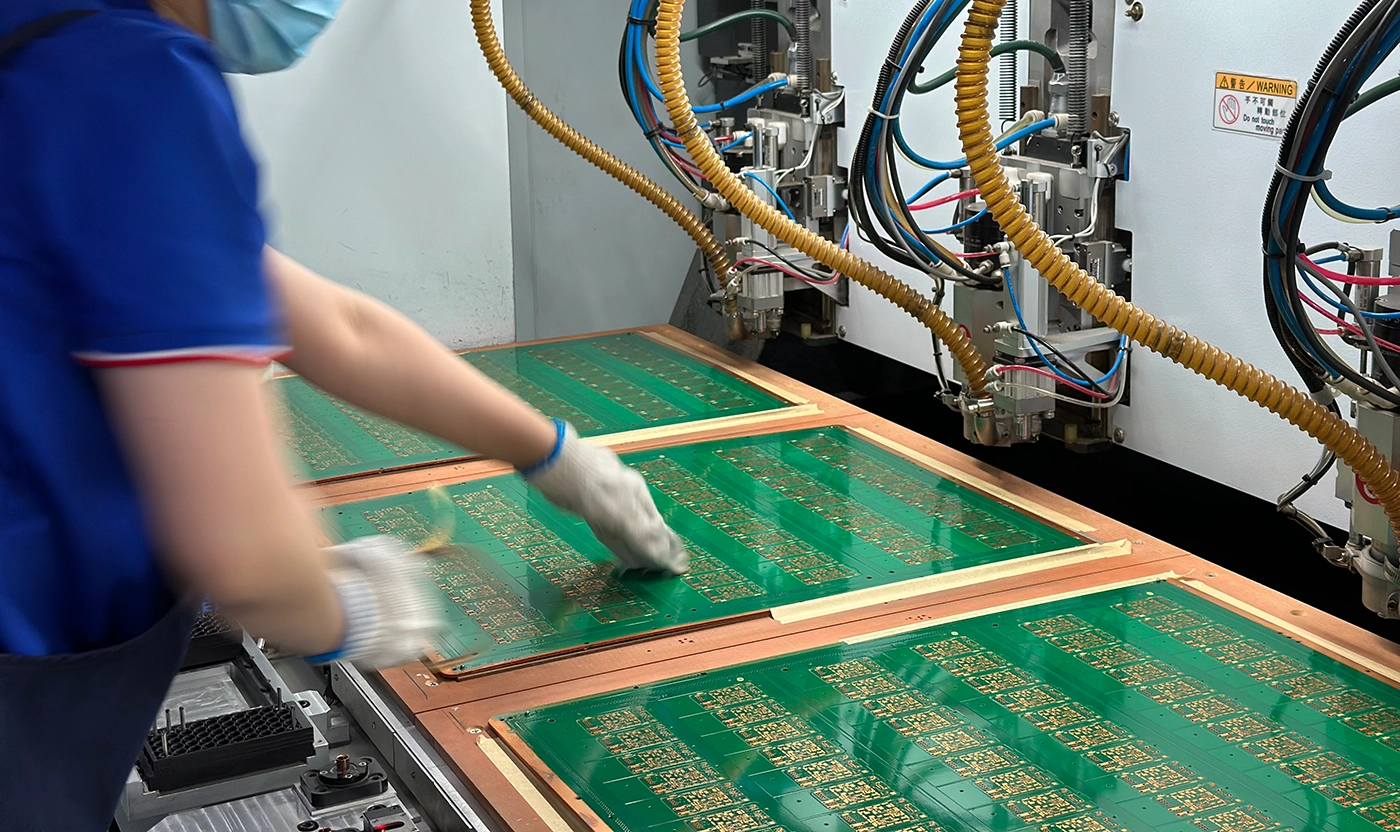
Printed circuit boards are at the heart of modern electronics. They connect components, conduct signals, and form the physical basis of every electronic assembly. Whether in smartphones, industrial plants, or e-mobility: nothing works without printed circuit boards.
At first glance, the manufacture of such circuit boards appears to be a clearly defined process. In reality, however, it is a highly complex production process involving many interdependent steps. It is precisely this complexity that makes production planning one of the greatest challenges in PCB manufacturing.
From layout to finished printed circuit board
It always starts with the layout of the printed circuit board. Developers define the electrical structure, select materials, and determine layer structure, conductor track widths, and via structures. These decisions are important because they have a direct impact on subsequent manufacturing. Specific materials, layer numbers, and structure sizes determine which processes are required and how complex they are. Once the design is complete, actual production can begin.
Typically, the process starts with copper-clad base material, often FR-4. The conductor structures are then created using exposure and chemical etching. In the case of multilayer PCBs, several of these structured layers are then pressed together under heat and pressure. This lamination process permanently bonds the individual layers together. This is followed by further precise manufacturing steps. Drilling machines create holes for components and through-plated connections, known as vias. These are then metallized to create electrical connections between the different layers. Finally, the circuit board is given its functional protective layers. Solder masks prevent short circuits, markings facilitate assembly, and surfaces such as ENIG or HASL ensure good solderability. Before the boards go into assembly, they are visually and electrically tested. Each of these steps is technologically demanding. However, the real difficulty arises not from a single process, but from their interaction.
That is why the production of printed circuit boards is so complex.
In practice, many different orders run through production simultaneously. These differ in terms of layer count, material, technology, and throughput time. While simple PCBs can be produced relatively quickly, complex multilayer boards require multiple press cycles, additional tests, or special surface processes. At the same time, many systems are bottlenecks. Presses, drilling machines, or certain chemical processes can only process a limited number of orders at the same time. Added to this are typical influences from everyday production. Rush orders have to be slotted in, materials arrive late, or boards fail quality testing and have to be reworked.
This transforms a seemingly linear process chain into a dynamic system with many interactions. This is precisely where it is decided whether production runs smoothly or has to be constantly replanned.
detailed scheduling a decisive factor in PCB manufacturing
The challenge therefore lies not only in the technology, but above all in the control of production. As soon as several orders run through different process steps at the same time, sequence planning becomes crucial. Many plants still work with traditional planning methods, such as ERP lists or Excel spreadsheets. This works as long as nothing changes. In reality, however, priorities, machine availability, and material deadlines are constantly changing. If a press cycle takes longer or an important order has to be brought forward, this has an impact on many other processes. Without the right tools, every change quickly turns into a time-consuming manual rescheduling process. This is exactly where modern detailed scheduling becomes detailed scheduling key lever.
Practical example: STARTEAM Global
One example of this is provided by the international circuit board manufacturer STARTEAM Global. The company works with complex production structures, different technologies, and a wide variety of variants. In an interview, Peter Gal describes how production control has changed there through the use of PAILOT.
A key advantage lies in the system's ability to continuously adjust production plans. If something changes in production, such as delays or priority changes, PAILOT automatically calculates a new optimal sequence for the orders. This significantly reduces the amount of manual planning required and ensures that decisions no longer have to be based solely on experience. Transparency also plays an important role. The PAILOT cockpit not only shows the current production plan, but also previous planning statuses. This makes it much easier to analyze bottlenecks and recurring problems. According to Peter Gal, this transparency leads to more stable production control and fewer spontaneous interventions in ongoing operations.
Conclusion
The manufacture of printed circuit boards is a highly precise and complex process. Many different production steps are interlinked and must be precisely coordinated. The greatest challenge lies not only in the technology, but also in the control of these processes. As soon as several orders run through a complex production process at the same time, detailed scheduling becomes detailed scheduling decisive factor. Examples such as STARTEAM Global show that intelligent planning systems such as PAILOT can help to dynamically adjust production plans, create transparency, and make manufacturing more stable overall. Ultimately, it is precisely this ability that determines whether PCB production is reliable and efficient.